
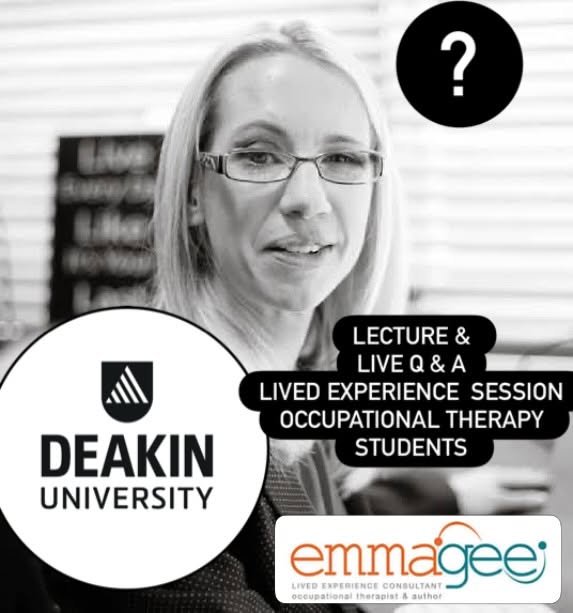
 I recently did a live Q & A session with 4th year Occupational Therapy students.
Here are the rough answers to some of the questions I was asked.
- What’s one lesson university or placement can’t easily teach?
“That the person is the expert in their own life. You can learn every assessment, model and intervention at university, but you can’t learn someone’s priorities, identity, fears and what makes their life meaningful from a textbook. You have to be curious enough to ask & humble enough to listen.”
- Did your OT knowledge influence your rehabilitation? Did it help you advocate or create pressure?
“Absolutely. My OT knowledge gave me language and confidence to advocate for myself and understand what was happening. But it was also a double-edged sword because sometimes felt I should know better, do better and be more ‘compliant’ because I was an OT. I had to learn that being an OT doesn’t make you less of a patient. Sometimes you just need to be the person receiving care.”
- What do professionals think they’re doing well that can feel very different to the patient?
“I think it’s listening. Clinicians can feel that they’ve listened because they’ve asked questions and gathered information, but listening isn’t necessarily the same as acting on what you hear. For me, person-centred care is when what I’ve told you actually changes what you do and the care you provide.”
- What made you feel most empowered and involved?
“The therapists who gave me choices, explained why we were doing something, and asked what mattered to me. I felt most empowered when therapists worked WITH me rather than doing things FOR me. Even small choices can give someone back a sense of control when so much of their life suddenly feels out of their control.”
- What advice do you have for graduate OT’s working with communication impairments?
“Slow down. Don’t confuse difficulty communicating with difficulty understanding. Make eye contact, give the person time, pay attention to their body language and don’t automatically direct your conversation to a family member or support person. Most importantly, communicate with the person (not about them).
And don’t be afraid of silence. Sometimes the most therapeutic thing you can do is give someone the time they need to participate.”
- How can we support resilience without creating pressure to be positive?
“Don’t make resilience another thing the person has to perform. Resilience isn’t about being positive every day. Sometimes resilience is getting through a really terrible day. Our role is to create the conditions that support resilience, not to tell someone they need to be resilient.”
- How do you manage meaningful activities vs clinical priorities in time-limited settings?
“I would challenge the idea that meaningful and clinical aren’t necessarily competing priorities. If swimming, cooking, returning to work or playing with your children is what matters to someone, that can become the context for rehab. The clinical goals can sit underneath the meaningful occupation rather than the occupation being an afterthought.
It’s great to ask: ‘What do you want to get back to doing?’ Then work backwards from there.”
- What about deficit-based assessments/reports while remaining strengths-based?
“We still need to document limitations honestly, but a person is not their list of deficits. I’d encourage students to document what the person CAN do, what supports them, what they value, what they’ve achieved and what strategies they use as well as what they can’t currently do. And remember that the words we put in a report can follow someone for years.”
- How could the music therapist and physio have collaborated better?
“They could have shared information and understood what each discipline was trying to achieve rather than working in separate silos. For example, if music was motivating me and helping me engage, the physio could have incorporated that into movement practice. And the music therapist could have understood the physical goals we were working towards. The person sits at the centre of both disciplines, so why shouldn’t the intervention?
I guess collaboration isn’t just professionals talking to each other, it’s creating one coherent rehabilitation experience for the person.”
- What do you wish more OT’s understood about supporting someone through stroke rehabilitation?
“Don’t just see the stroke. See the person who existed before it, the person they are now, and the person they still want to become. Recovery is not linear, and rehabilitation isn’t just about improving function. It’s about rebuilding a life. Sometimes the most important occupational goal isn’t the one that looks most impressive clinically, it’s the one that makes the person feel like themselves again.”
At the end of the session I said something like –
“You will leave university with knowledge, clinical skills and evidence-based practice. But please don’t leave your curiosity behind. You will never know more about what it is like to live in someone else’s body, life and circumstances than they do. Your job isn’t to become the expert on the person. Your job is to become an expert at working WITH them.”