
 Today was a big communication day for me.
Twenty years after my stroke, communication is still one of the things that requires the most energy. Articulating clearly can take enormous concentration, and speaking for long periods can be physically and mentally exhausting.
Today I had back-to-back trials with Occupational Therapists that required almost constant communication for around four hours. Four hours of explaining, answering questions, clarifying, sharing experiences, and staying present in conversation.
For many people, that might sound like a normal work day filled with meetings.
For me, it’s a marathon.
Communication challenges have been HUGE and ongoing since my stroke. I write in my book:
“I longed for a means to convey my needs. The images on the communication board given to me by my speech therapist were so tiny I had difficulty seeing them. Also, my ataxia meant that my shaky indecisive fingers would inevitably point to the wrong picture. I’d be bombarded with piles of white hospital blankets when the truth was I was hungry! Eager to lessen my frustration and understand my needs, Bec drew a picture board with large icons. A later version was a letter board, a keyboard printed on paper. I managed to shakily spell out ‘CAT’ and ‘MUM’ but in my mind I needed to spell out something to prove to my therapist that I was all there. I decided on the words ENERGY CONSERVATION.” Reinventing Emma, page 104
One of the lasting effects of my stroke is the effort required to speak since my voice gets tired and the sheer cognitive load of communicating continuously builds quickly. By the end of long conversations I can feel completely depleted.
But today something made a real difference.
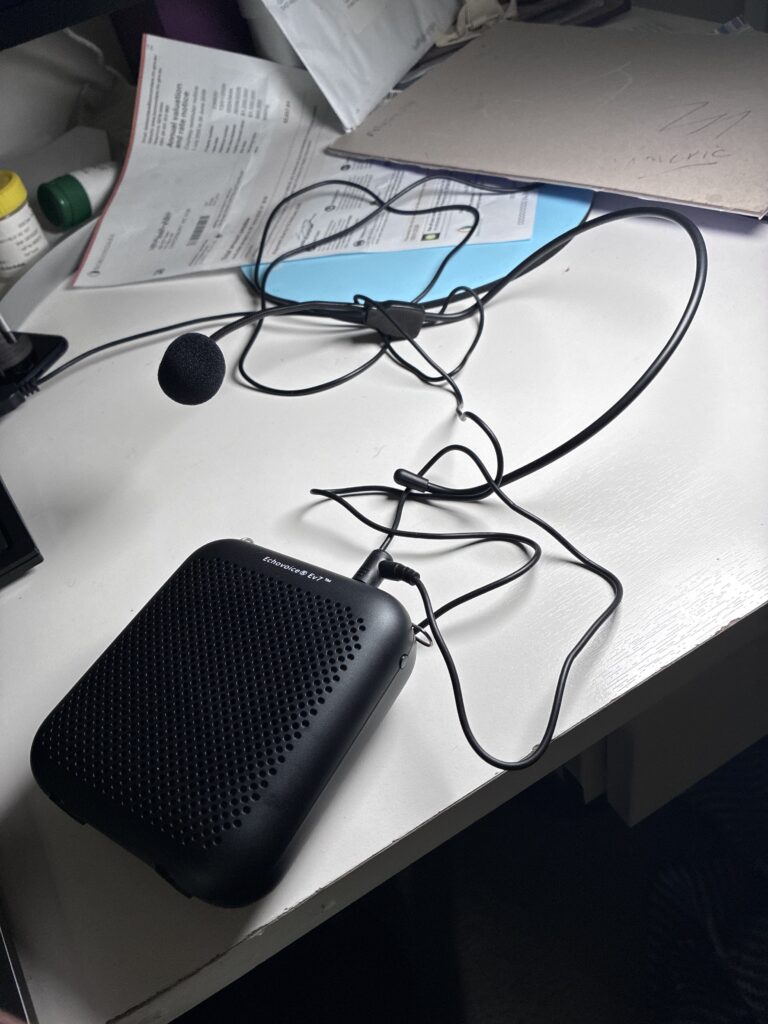
I now have a small voice amplifier. It’s a piece of assistive technology that allows me to project my voice without forcing it. Instead of pushing every word out with so much effort, the amplifier carries the sound for me. It might seem like a small device but for me, it’s transformative.
It meant that I could keep communicating for longer and focus on the content of what I was saying, rather than using all my energy just to be heard.
Assistive technology is often talked about in terms of independence and mobility; equipment such as wheelchairs and walkers.
But communication aids matter just as much. Being able to express your thoughts, share your experience, contribute professionally, and connect with others is fundamental to participation in life. When technology supports that, it doesn’t just amplify a voice, it amplifies opportunity.
Twenty years on from my stroke, I’m still adapting, still learning, still discovering tools that make life more possible and today, I am incredibly grateful for a small amplifier that helped carry my voice through four very full hours.